


Reforestation phase three:
A series of discussions were held by ADHENO with community members of Moy to identify the key needs of the community and assess the types of projects they were willing to commit to and invest their time and effort in. As has been demonstrated through various projects implemented by ADHENO in this area, the full support and participation of the community is the single most important success factor in a project. Since the community is willing to support only projects that meet their stated needs, this discussion with the local community was a critical part in formulating project activities for phase 3.
Phase 3 was implemented in the villages of Amoragedel, Moy, and Kasset, all within Moy Kebele. It was funded via a Christensen Fund grant of $86,300 USD that Dir Biyabir won in November 2012. Implementation period ran from January 2013 to December 2014.
Since the project area is extremely poor and neglected (even by Ethiopian standards), the community was understandably focused on projects that would allow them to generate income. Having participated in and seen the impact of ADHENO’s environmental projects in the area, they were very impressed and satisfied by the renewal of the landscape and the protection of soil and water, However lacking enough to eat and to support their families, they also communicated a great need to find a way to generate additional income and to send their children to school as a way to escape extreme poverty at some point. In addition to afforestation and biodiversity, ideas for such income generating activities that were of great interest in the community were discussed. The lack of better footpaths/horsepaths was also a great concern for the community as it hindered their ability to take their goods to market and hindered their children from going to school.
Key accomplishments in Phase 3 include the following:
A) Environmental
- 192 farmers trained on building soil and water conservation mechanisms such as stone and soil bunds and check dams. Tools provided (50 pick axe, 50 spades, 50 hammers and 50 digging bars)
- 142,400 trees planted including over 70,000 indigenous trees (no eucalyptus was planted)
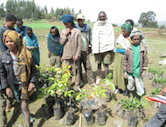
- 342 villagers including 80 women were trained on producing, nurturing and planting tree seedlings
- New nursery station established in Kaset Tig village, while an existing nursery station in Kaset Michael (from phases 1 and 2) was strengthened.
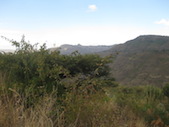
- Developed five closure sites covering 8 hectares (about 20 acres) of land. No grazing or human activity is allowed in sites so natural vegetation cover in this areas has now fully recovered.
- Over 140 types of traditional medicinal plants planted in the two nursery stations to preserve and improve the biodiversity of the area
- Farmers improved conservation of 590 hectares (1,458 acres) of land by building various soil and water conservation structures including contour bund, check dam, trenches and half moons. This has arrested soil erosion by reducing the speed of runoff water.
- Planted Vetiver grass on 2,000 square meter of land. Vetiver is deep rooted and holds the soil
 |
 |
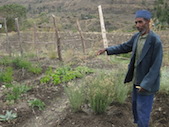 |
| Seedling Station at Kasset Tig | Closure Site at Kasset is Recovering Vegetation Cover | Qes Lakew with traditional medicinal plants |
B) Economic Empowerment
- Constructed 11.5 km foot path which has significantly improved access to local market for over one thousand villagers so they can easily sell their products and gain economic benefit.
- 20 rural youth trained on bee-keeping and provided 26 bee hives. They are expected to produce over 400 kilos of honey.
- 80 women living in extreme poverty were organized into self help groups and trained on how to manage and save money and run a small business. They are now engaged in lucrative micro-enterprises including sheep fattening, preparing local spices, etc and have now started to generate revenue out of their business. Some of these women were trained on cotton spinning and they have now started to deliver partially produced cotton products to local textile producers and are earning additional income.
- 2,500 varieties of grafted orange, apple, mango, avocado, papaya, banana and coffee were distributed. 20 kilos of vegetable seeds including carrot, cabbage, tomato, onion, beet root were distributed. These fruits and vegetables are now producing and villagers have access to fresh fruits and vegetables for their own consumption as well as the opportunity to sell the excess and earn additional revenue.
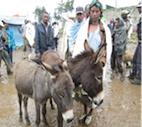
- Two women potters were each given a donkey to transport clay as well as finished pottery. They had been previously carrying the load on their backs resulting in significant bodily harm
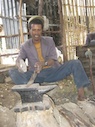
- Four traditional black smiths were given training to produce better products and provided tools. Now they repair farming equipment locally and farmers no longer travel far for repairs needed.
 |
 |
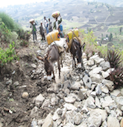 |
| Woman Potter with her new donkey | Blacksmith with his new tools | Using the newly constructed footpath |
C) Education and Health
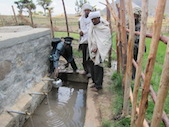
- Constructed 2 springs which are now providing clean water to over 100 households (about 500 people). The springs were constructed in the villages of Amoragedel and Meskelyes and both have a reservoir with capacity of 4 cubic meters.
- 42 residents (10 adults and 32 children) were examined for intestinal parasites, and de-worming treatment was given to all positive (100% of adults and 59% of children) in collaboration with Debre Birhan University.
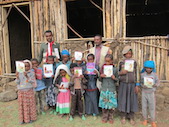
- Constructed one classroom block consisting of three separate classrooms at the Amoragedel Satellite school . This has enabled a total of 150 local village children from grade 1 to 3 to attend school without traveling very long distances
- Organized experience sharing visit to the Konso area in Southern Ethiopia, attended by 15 farmers (including two women). Farmers studied and learned from traditional soil and water conservation practices of the Konso people.
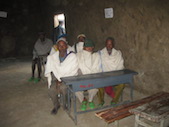
- Completed construction of a community center/Farmer Training Center (FTC) that villagers had started but were unable to complete. Equipped the center with training modules, bee hives, fuel saving stove, as well as materials used for weaving , metal work and pottery. This center has become a meeting place for the community to discuss their issues as well as training center to learn new practical skills.
- Adult education provided to 287 farmers (87 women) to reach an acceptable level of literacy as well as basic health and hygiene issues.
 |
 |
 |
 |
| Children at Amoragedel School while its constructed | New spring at Amoragedel | Farmers at New FTC | Fruit Tree Distribution |
|
|
|